
SPC vs WPC Hybrid Flooring: What’s the Difference?

You’ve narrowed it down to hybrid flooring. Then you discover SPC and WPC, two products that look nearly identical on the showroom floor but perform very differently under your feet.
The wrong choice means a floor that cracks, feels hollow, or buckles in the one room you needed it to last.
We will make you understand exactly how SPC and WPC differ, where each one excels, and which to choose for your specific situation.
- What Is Hybrid Flooring?
- What Is SPC Flooring?
- What Is WPC Flooring?
- SPC vs WPC: Core Construction Compared
- Head-to-Head Comparison Table
- Which Is Better for Wet Areas?
- Which Is Better for Comfort and Noise?
- Which Is Better for High-Traffic Areas?
- SPC vs WPC: Cost Difference
- Which One Should You Choose?
- Conclusion
- FAQ
What Is Hybrid Flooring?
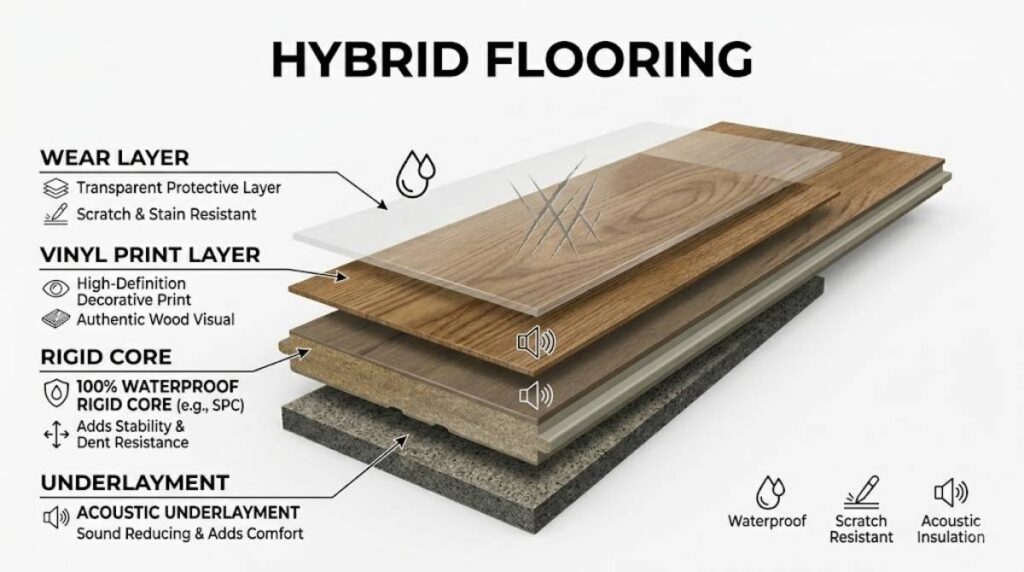
Hybrid flooring is a rigid-core vinyl plank product that combines the water resistance of LVT (luxury vinyl tile) with the dimensional stability of laminate. It has a layered construction: a rigid core, a printed vinyl layer, and a protective wear layer on top.
The “hybrid” label covers two distinct core technologies: SPC (Stone Plastic Composite) and WPC (Wood Plastic Composite). Both fall under the hybrid category, but their core materials produce very different physical characteristics.
Before committing to either core type, it is worth understanding how hybrid flooring stacks up against laminate, since both compete at similar price points but handle moisture and subfloor movement very differently.
Rigid core flooring, which includes both SPC and WPC, now accounts for 57.3% of total resilient flooring dollar sales in the US, generating $4.8 billion of the $8.381 billion resilient market in 2024, according to Floor Covering News industry research.
What Is SPC Flooring?
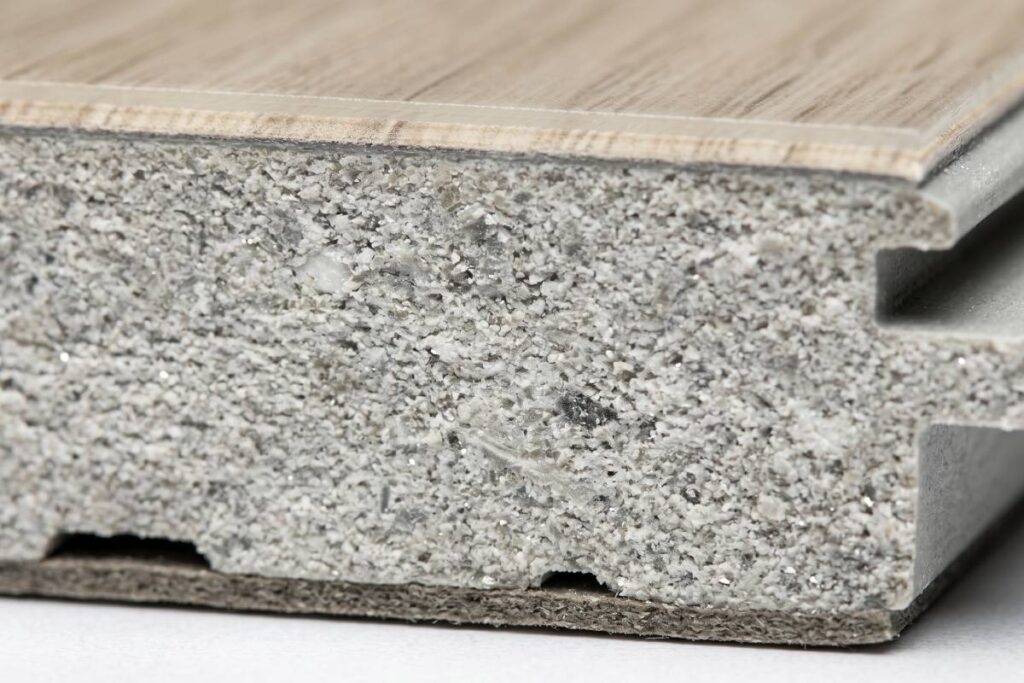
SPC stands for Stone Plastic Composite. The core is made from a dense mixture of limestone powder, PVC, and stabilisers. That combination produces an extremely hard, dimensionally stable board.
SPC cores are typically 3.2mm to 5mm thick. Because the core is so dense, it resists temperature fluctuation better than WPC and handles heavy loads without compression.
What Is WPC Flooring?
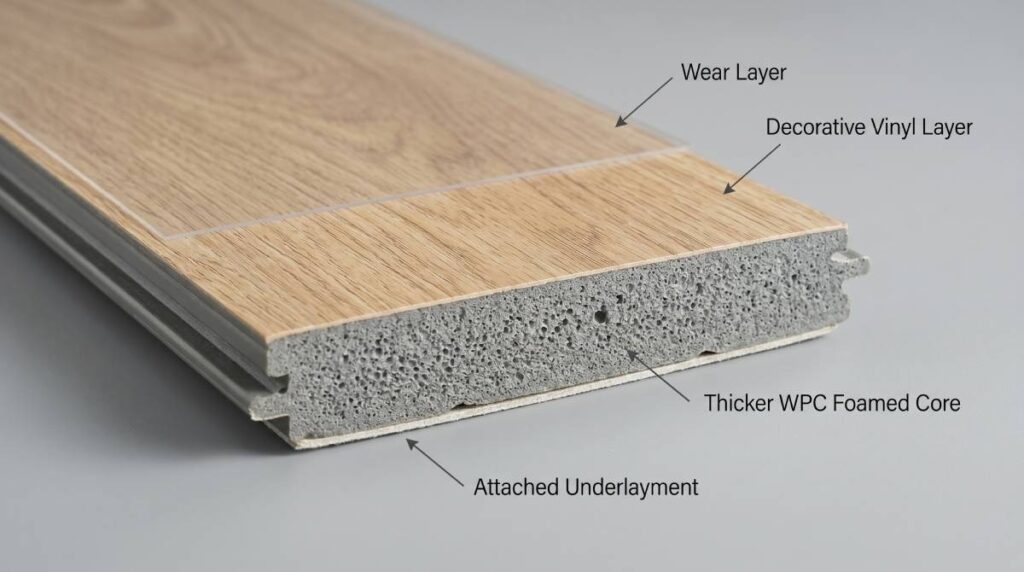
WPC stands for Wood Plastic Composite. The core is a foamed composite of wood fibre (or wood flour), PVC, and plasticisers. The foaming process creates air pockets within the core, giving it a softer, more cushioned feel.
WPC cores are typically 6mm to 8mm thick. That extra thickness, combined with the foamed structure, produces better underfoot comfort and acoustic dampening compared to SPC at the same overall plank thickness.
SPC vs WPC: Core Construction Compared
Density and Hardness
SPC is denser and harder than WPC. An SPC plank at 4mm feels more rigid underfoot than a WPC plank at 7mm. That density is an advantage in high-traffic and commercial settings where board compression over time is a concern.
WPC’s foamed core is softer by design. It gives slightly under load, which makes it more comfortable for long periods of standing, but less suitable for very heavy furniture or rolling loads.
Dimensional Stability
SPC wins on dimensional stability. Its stone-based core resists thermal expansion and contraction better than WPC’s wood-fibre core. In rooms with large temperature swings, such as sunrooms or spaces with radiant heating, SPC holds its shape more reliably.
WPC can expand and contract more with temperature changes. This is not a dealbreaker in climate-controlled rooms, but it is a genuine limitation in Australian conditions with wide temperature ranges.
Thickness and Subfloor Tolerance
WPC’s greater thickness makes it more forgiving over imperfect subfloors. The foamed core can bridge minor undulations in a concrete slab or timber subfloor better than a thin, rigid SPC plank.
SPC requires a flatter subfloor. Any high spots above the manufacturer’s specified tolerance (usually 3mm over 1.8m) will show as peaks or create stress points on a rigid SPC plank.
Head-to-Head Comparison Table
| Feature | SPC | WPC |
| Core material | Limestone + PVC | Wood fibre + PVC (foamed) |
| Typical core thickness | 3.2mm to 5mm | 6mm to 8mm |
| Density | High (1.8–2.0 g/cm³) | Medium (1.0–1.3 g/cm³) |
| Underfoot comfort | Firm | Cushioned |
| Acoustic dampening | Moderate | Better |
| Waterproof | Yes (100%) | Yes (100%) |
| Thermal stability | Excellent | Moderate |
| Subfloor tolerance | Less forgiving | More forgiving |
| Heavy furniture suitability | Excellent | Good |
| Typical price (AUD per m²) | $35–$65 | $45–$80 |
| Best application | High-traffic, wet areas, commercial | Bedrooms, living areas, imperfect subfloors |
Which Is Better for Wet Areas?
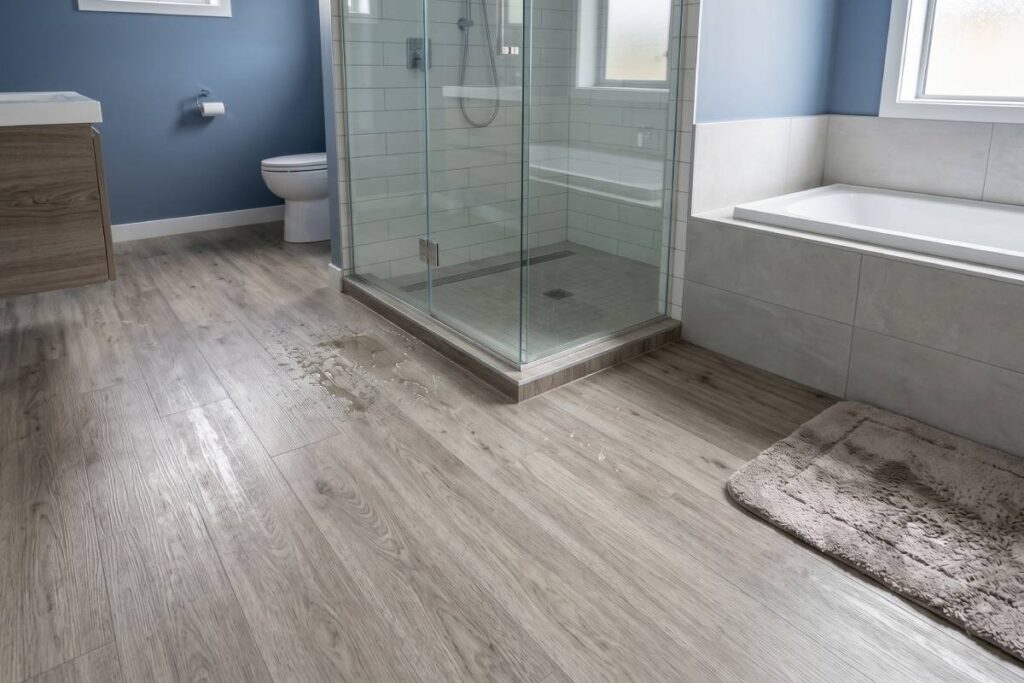
Both SPC and WPC are 100% waterproof at the core level. Water will not swell or warp either product. However, the difference is in performance under water exposure over time.
SPC handles standing water and sustained moisture better. Its denser core has no foamed air pockets that could, under extreme conditions, allow moisture to track via the join profile rather than the core.
For bathrooms, laundries, and kitchens in Australian homes, SPC is the safer specification. Its dimensional stability under wet conditions reduces the risk of gapping at board joins if temperature and humidity fluctuate.
Which Is Better for Comfort and Noise?
WPC is meaningfully softer underfoot. If you are renovating a bedroom, a living room, or any space where you spend long periods standing or walking barefoot, the foamed WPC core makes a noticeable difference to fatigue.
WPC also performs better acoustically. The foamed core absorbs impact sound more effectively, which matters in apartments or two-storey homes where noise transmission between floors is a concern.
SPC can feel harder and transmit more impact noise. Many SPC products compensate with a thicker pre-attached underlayment (2mm to 3mm foam or cork), which helps but does not fully close the gap with a naturally foamed WPC core.
Which Is Better for High-Traffic Areas?
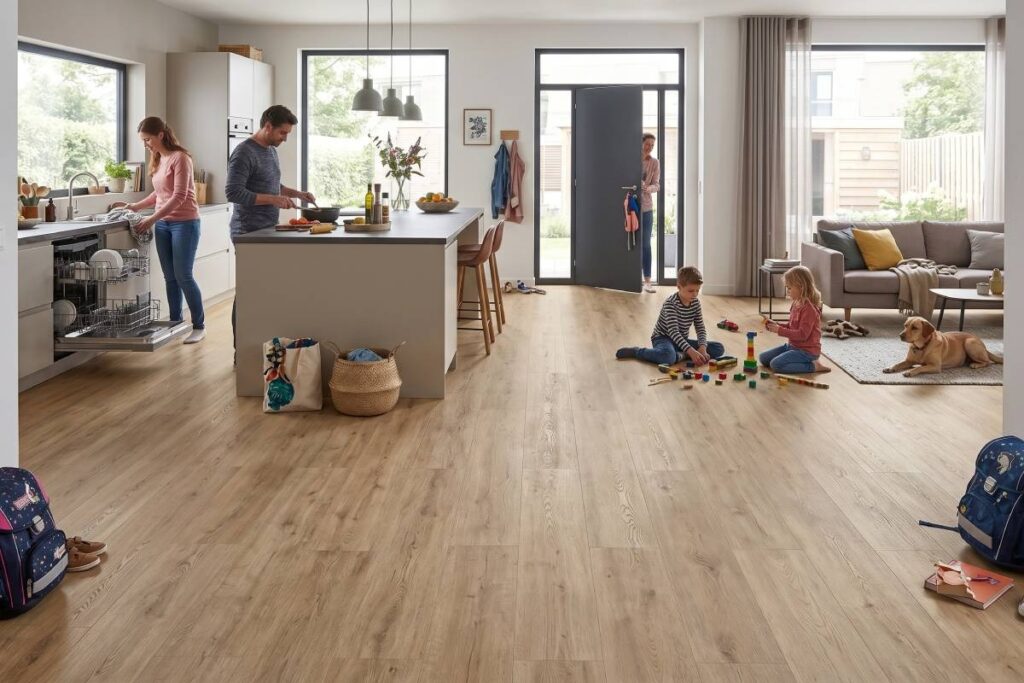
SPC’s density gives it an edge in high-traffic environments. Hallways, open-plan living and dining areas, commercial fit-outs, and rentals all benefit from a core that resists compression and indentation from heavy foot traffic and furniture legs.
WPC’s foamed structure can compress over time under heavy point loads, such as the leg of a heavy bookshelf or a dining chair without felt pads. This is not a structural failure, but it can leave visible marks in the wear layer.
For rental properties and family homes with pets, SPC is the more practical choice.
SPC vs WPC: Cost Difference
SPC is generally cheaper than WPC at equivalent quality tiers. The manufacturing process for a dense stone-based core is more cost-efficient than producing a foamed wood-composite board at greater thickness.
In the Australian market, entry-level SPC starts around $35–$45 per m², while comparable WPC typically starts at $45–$55 per m². Premium products in both categories can exceed $70 per m² before installation.
The cost gap narrows when you factor in installation. WPC’s greater subfloor tolerance can reduce the cost of floor preparation, which in Australia runs $15–$40 per m² for grinding or levelling a concrete slab.
If budget is the primary driver, understanding the cost difference between hybrid and vinyl flooring will clarify whether the higher rigidity and waterproof performance of either core type justifies the price premium over standard LVT.
Which One Should You Choose?
Choose SPC if:
- You are tiling over a well-prepared concrete slab
- The room is a bathroom, laundry, or kitchen
- The space gets heavy foot traffic or sees children and pets daily
- Your climate has wide temperature swings
- Budget is a consideration
Choose WPC if:
- Your subfloor has minor imperfections that you cannot easily grind flat
- The room is a bedroom, home office, or living area where comfort matters
- You are in an apartment, and acoustic performance is a priority
- You want a warmer, softer feel underfoot
Neither product is universally superior. The right choice comes down to the specific conditions of your room and the way you use the space.
Conclusion
SPC and WPC hybrid flooring share the same waterproof, floating-floor format but serve different purposes. SPC wins on dimensional stability, density, and durability in demanding conditions; WPC wins on underfoot comfort, acoustic performance, and forgiveness over imperfect subfloors. Match the core to the room’s specific demands, and you will not have to replace it.
FAQ
What is your reaction?


You may also like

Best Flooring for Dogs and Cats: What Actually Holds Up