Is Hybrid Flooring More Expensive Than Vinyl?

To Long; Didn’t Read
Yes, hybrid flooring is more expensive than vinyl flooring at almost every quality tier.
In Australia, a hybrid costs $50–$100/m² fully installed versus vinyl’s $25–$90/m². The gap is real, but it is not always large, and at the premium end of vinyl, you can end up spending close to what a mid-range hybrid costs anyway.
The more useful question is not whether a hybrid costs more. It is whether the extra cost is justified for your specific situation. That depends on three things: the quality tier you are comparing, the room you are flooring, and how long you plan to stay in the property.
What You’re Actually Comparing
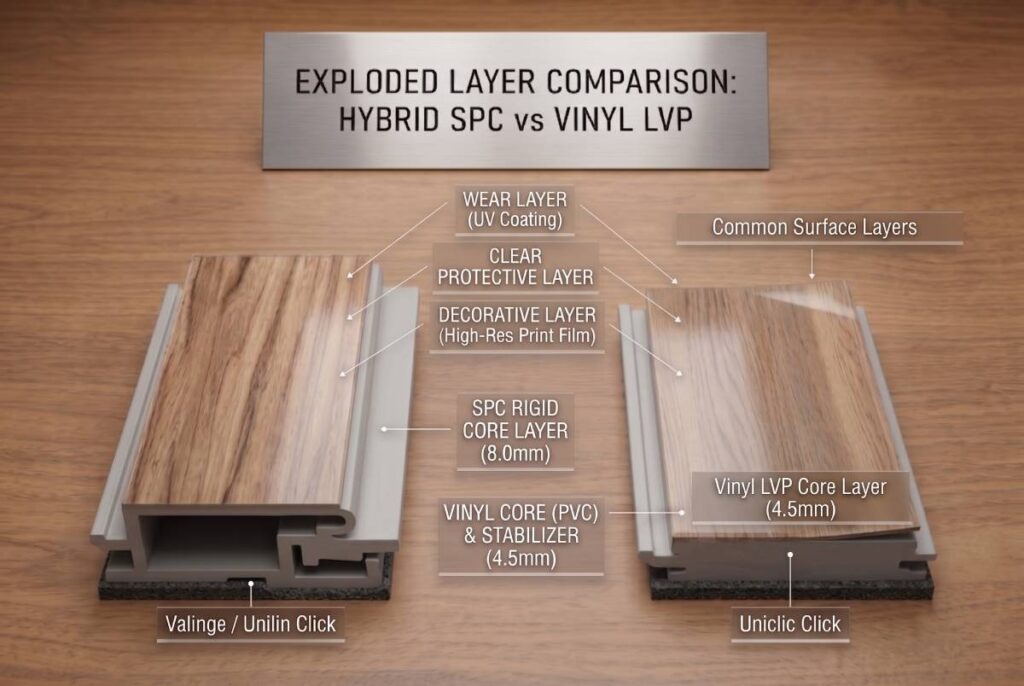
Both products are multi-layer, waterproof, and designed to mimic timber. The difference sits in the core.
Vinyl (specifically luxury vinyl plank, or LVP)
Uses a 100% PVC core. It is flexible, fully waterproof, and well-suited to glue-down or click-lock installation. The trade-off is that a pure PVC core expands and contracts with temperature changes, which creates limits in rooms with extreme heat fluctuations, like sunrooms and covered decks.
Hybrid flooring
Uses a rigid composite core, either SPC (stone plastic composite, a mix of PVC and limestone) or WPC (wood plastic composite, a mix of PVC and wood fibre). That rigid core makes the hybrid dimensionally stable across a wider temperature range, adds underfoot density, and typically comes with a built-in acoustic underlayer. That extra engineering is exactly what adds to the cost.
Supply and Installation
The table below is based on current Australian market pricing as of 2025.
| Quality Tier | Vinyl Supply Only | Vinyl Installed | Hybrid Supply Only | Hybrid Installed |
| Budget | $16–$30/m² | $35–$55/m² | $30–$45/m² | $55–$70/m² |
| Mid-Range | $30–$50/m² | $55–$80/m² | $45–$75/m² | $75–$105/m² |
| Premium | $50–$65/m² | $80–$90/m² | $75–$120+/m² | $105–$150+/m² |
Installation rates: $20–$40/m² for vinyl (basic click-lock); $30–$60/m² for hybrid, depending on subfloor condition and room complexity. Subfloor levelling adds $10–$90/m² on top of these figures and applies to both products equally
Why Hybrid Costs More
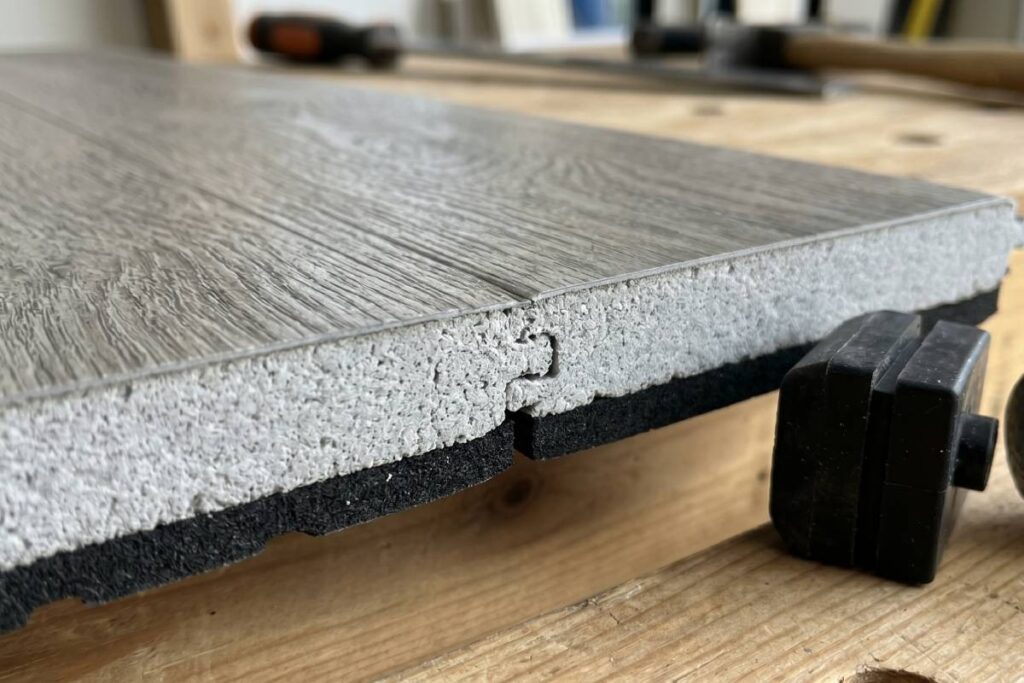
Three specific features push a hybrid’s price above a vinyl’s.
Rigid core manufacturing
Milling and compressing limestone or wood fibre into a stable composite core is more complex and material-intensive than extruding a flat PVC sheet. That difference starts at the factory and flows through to the retail price.
Built-in acoustic underlayer
Most mid-range and premium hybrid boards include a pre-attached foam or cork underlayer. With vinyl, underlayment is a separate purchase, typically $5–$15/m² extra. When you add that back to vinyl’s installed cost, the gap between the two products narrows significantly at the mid-range tier.
Wear layer thickness
Premium hybrid boards carry a 0.5mm–0.7mm wear layer versus 0.3mm–0.5mm on equivalent vinyl. A thicker wear layer extends the floor’s usable life in high-traffic areas before the print layer becomes visible. You are paying for fewer replacement cycles over 20 years, not just a thicker piece of plastic.
What Drives Vinyl’s Price Variation
Vinyl plank flooring
In Australia, prices range from $25 to $80 per square metre, depending on product type and quality, with professional installation adding between $20 and $80 per square metre for standard to complex jobs.
Budget vinyl (under $30/m² supply)
Typically has a 0.2mm–0.3mm wear layer, no attached underlay, and a thin total board profile of 4mm–5mm. These products are adequate for rental properties and low-traffic rooms but will show wear within five to eight years under normal family use.
Mid-range vinyl ($30–$50/m² supply)
Adds a 0.5mm wear layer, an attached foam backing, and a more realistic embossed surface texture. This tier is where vinyl becomes a legitimate long-term floor rather than a cost-saving stopgap.
Premium LVP ($50–$65/m² supply)
Closes much of the performance gap with mid-range hybrid. At this price point, the primary reason to choose hybrid over vinyl shifts from durability to temperature stability and underfoot density, not raw wear performance.
Long-Term Cost: Where the Math Shifts
Upfront cost is only part of the calculation. The replacement cycle changes the total spend significantly.
A budget vinyl floor in a busy living area may need replacing within 8–10 years. A mid-range hybrid in the same room, with a 0.5mm wear layer and a rated lifespan of 20–25 years, effectively costs the same or less per year of use despite a higher upfront price.
For a 60m² living and dining space:
- Budget vinyl installed: $3,000 upfront. Replace at year 10. Total over 20 years: $6,000 plus a second installation disruption.
- Mid-range hybrid installed: $5,400 upfront. No replacement needed at 20 years. Total: $5,400.
This is not a universal argument for a hybrid. In a rental property where floors are replaced between tenants anyway, budget vinyl at $35–$55/m² installed makes more financial sense than a hybrid at nearly double the cost.
When Hybrid Is Worth the Premium
Your home has direct sun exposure or temperature swings
Sunrooms, rooms with large west-facing windows, or open-plan spaces connected to covered outdoor areas all expose flooring to heat fluctuations that can cause pure PVC vinyl to buckle or gap at joins. Hybrid’s rigid SPC core tolerates these conditions without movement.
You want one floor throughout the whole house
Hybrid’s dimensional stability and acoustic performance make it a better choice for a consistent floor across different room types, including over concrete slabs and timber subfloors in the same home.
You are renovating to sell
The perceived premium of hybrid flooring is a visible upgrade that buyers register. It is also less likely to need attention before settlement.
When Vinyl Is the Right Call
Rental properties and investment renovations
The cost difference between budget vinyl and entry hybrid across a full property can easily exceed $5,000–$8,000 on a standard Australian home. That gap is rarely recovered in additional rent.
Rooms with irregular subfloors
Vinyl’s flexibility allows it to conform to minor subfloor imperfections better than a rigid hybrid board. If subfloor levelling costs are high, vinyl can reduce overall project spend.
Tight renovation budgets with a short timeline
Mid-range vinyl installed for $55–$75/m² delivers a durable, waterproof, good-looking floor that will last a decade or more. It is not a compromise for most homeowners with a 5–10 year horizon.
A reader still deciding whether hybrid is the right category at all should also weigh up laminate vs hybrid flooring, since laminate sits closer to vinyl on price and shares several of the same limitations.
Conclusion
Hybrid flooring is more expensive than vinyl at every quality tier, with installed costs typically running $20–$30/m² higher across the mid-range. That gap closes when you factor in vinyl’s separate underlayment cost and widens when you account for hybrid’s longer replacement cycle. The right choice depends on your property type, the room’s conditions, and how long you need the floor to perform, not just the upfront price tag.
FAQ
What is your reaction?


You may also like

Best Flooring for Dogs and Cats: What Actually Holds Up