Laminate vs Hybrid Flooring: Which Should You Choose?

Both laminate and hybrid flooring look nearly identical in a showroom. The difference is what happens after a wet mop, a dog with muddy paws, or a summer in Queensland.
Pick the wrong product for your space, and you will be pulling up buckled boards inside five years.
I will bring you to know every meaningful difference, so you walk into a flooring store knowing exactly what to ask for.
- What Is Laminate Flooring?
- What Is Hybrid Flooring?
- Waterproofing and Moisture Resistance
- Durability and Scratch Resistance
- Underfoot Comfort and Sound
- Cost: Purchase Price vs. Cost of Ownership
- Installation
- Room-by-Room
- Australian Climate Considerations
- Environmental and Off-Gassing Factors
- The Verdict: Which Floor Wins?
- FAQ
What Is Laminate Flooring?
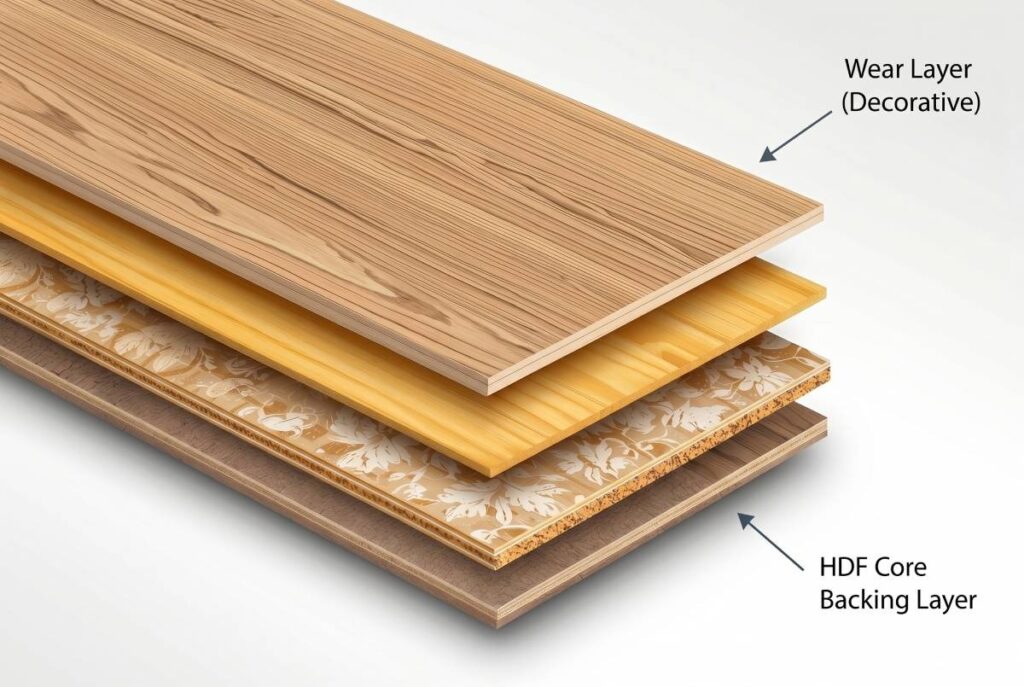
Laminate is a synthetic product built from four bonded layers: a stabilising backing, a high-density fibreboard (HDF) core, a printed décor layer that mimics timber or stone, and a protective wear layer sealed on top.
The HDF core is its defining characteristic. It gives laminate exceptional rigidity and contributes to strong scratch resistance, but it also absorbs water. Sustained moisture contact will cause the core to swell, warp, and delaminate.
Laminate has been the dominant affordable timber-look flooring in Australia for two decades. The technology is mature, supply is plentiful, and quality at the mid-to-upper range is genuinely good.
What Is Hybrid Flooring?

Hybrid flooring combines a waterproof polymer core (either Stone Plastic Composite/SPC or Wood Plastic Composite/WPC) with a printed décor layer and a wear layer similar to laminate. The result is a floor that is 100% waterproof throughout its entire construction.
SPC is denser and more dimensionally stable. WPC is slightly softer underfoot due to a foam-infused core. Both are fully waterproof.
Hybrid is a newer product category, and it was largely engineered in response to laminate’s one major weakness: water. It borrows the best structural quality from laminate (rigidity, realistic print layers, AC-rated wear) and replaces the vulnerable HDF core with an inert polymer composite.
The practical performance differences between SPC and WPC hybrid cores determine which product is right for your subfloor condition and climate zone, not just your budget.
Waterproofing and Moisture Resistance
This is the most important difference between the two products, and it is not close.
Laminate is water-resistant, not waterproof. The surface can tolerate quick spills if wiped immediately. However, water that penetrates the joints, sits on the surface for more than a few minutes, or gets underneath the boards will damage the HDF core. These rules apply to bathrooms, laundries, and any kitchen subject to regular wet mopping.
Hybrid flooring is fully waterproof at the core level. The SPC or WPC material will not swell, warp, or delaminate regardless of moisture exposure. It can be installed in bathrooms, laundries, kitchens, and even covered outdoor areas. The only caveat is that prolonged water pooling under the floor (from a leak or flood) can affect the adhesive in a glue-down installation.
Bottom line:
If there is any realistic moisture risk in the space, hybrid is the only responsible choice.
Durability and Scratch Resistance
Laminate’s wear layer is rated using the Abrasion Class (AC) system, which runs from AC1 (light residential) to AC5 (heavy commercial). Most quality residential laminate sits at AC3 or AC4. An AC5 laminate is genuinely difficult to scratch under normal household conditions.
Hybrid flooring uses a wear layer measured in mils (thousandths of an inch). A 12-mil wear layer is adequate for standard residential use. A 20-mil layer handles pets, heavy foot traffic, and furniture movement without issue.
High-end laminate at AC4 or AC5 outperforms most hybrid products on raw scratch resistance. The aluminium oxide finish in a premium laminate wear layer is hard to beat on that single metric. However, hybrid floors at 20-mil and above close that gap significantly in everyday use.
For dent resistance, hybrid has the advantage. The rigid polymer core absorbs impact better than HDF, which can dent under heavy furniture on soft subfloors.
Underfoot Comfort and Sound
HDF is a hard, dense material. Standard laminate without an acoustic underlay sounds hollow underfoot and can feel cold in winter. Most laminates require a separate underlay to address both issues, adding to the installation cost and complexity.
Most hybrid flooring comes with an attached acoustic backing, typically 1mm to 2mm of foam or cork. This reduces hollow sound, adds minimal cushioning, and eliminates the need to purchase a separate underlay in most cases.
In practical terms, a hybrid feels noticeably quieter and slightly softer underfoot than an equivalent laminate without underlay. The difference is meaningful in two-storey homes or apartments where noise transfer between floors matters.
Cost: Purchase Price vs. Cost of Ownership
Australian pricing (supply only) sits at roughly $20 to $35 per square metre for laminate and $35 to $55 per square metre for hybrid, depending on brand and thickness.
The $35–$55 per square metre supply price is only part of the equation, and hybrid flooring supply and installation costs vary significantly depending on board thickness, brand tier, and whether your subfloor needs preparation work.
That gap narrows when you factor in total cost. Laminate typically requires a separate underlay ($5 to $15/m²), while hybrid usually does not. Laminate installed in an area that later experiences moisture damage costs the same again to replace.
The smarter way to compare is cost per year of use. A hybrid floor installed in a kitchen that lasts 25 years without incident costs less over time than a laminate that needs replacing at year eight because of water damage.
| Feature | Laminate | Hybrid |
| Core material | HDF (wood fibre) | SPC or WPC (polymer composite) |
| Waterproof | No | Yes |
| Scratch resistance | High (AC3-AC5) | Moderate-High (12-20mil) |
| Dent resistance | Moderate | High |
| Underfoot comfort | Moderate | Better (built-in underlay) |
| Sound insulation | Requires separate underlay | Built-in acoustic backing |
| Cost per m² (AU, supply) | $20-$35 | $35-$55 |
| Separate underlay needed | Usually yes | Usually no |
| Suitable for wet areas | No | Yes |
| Temperature stability | Moderate (expands/contracts) | High (minimal movement) |
| Estimated lifespan (dry area) | 15-25 years | 20-30 years |
Installation
Both products use click-lock systems and float over the subfloor without glue or nails in most residential applications. Either product can be tackled by a competent DIYer with basic tools.
The practical differences in installation are:
Subfloor tolerance
Hybrid SPC is less forgiving of an uneven subfloor than WPC or laminate. Rigid SPC planks will rock over high spots rather than flex over them. Subfloor preparation matters more with SPC hybrid.
Acclimation
Laminate needs 48 to 72 hours of acclimation in the room before installation to stabilise to the ambient humidity. Most SPC hybrid products require minimal acclimation due to their dimensional stability.
Expansion gaps
Both require perimeter expansion gaps, but hybrid requires smaller gaps due to its low thermal expansion coefficient.
Underlay
Laminate requires a separate underlay step. Hybrid with pre-attached backing does not.
Room-by-Room
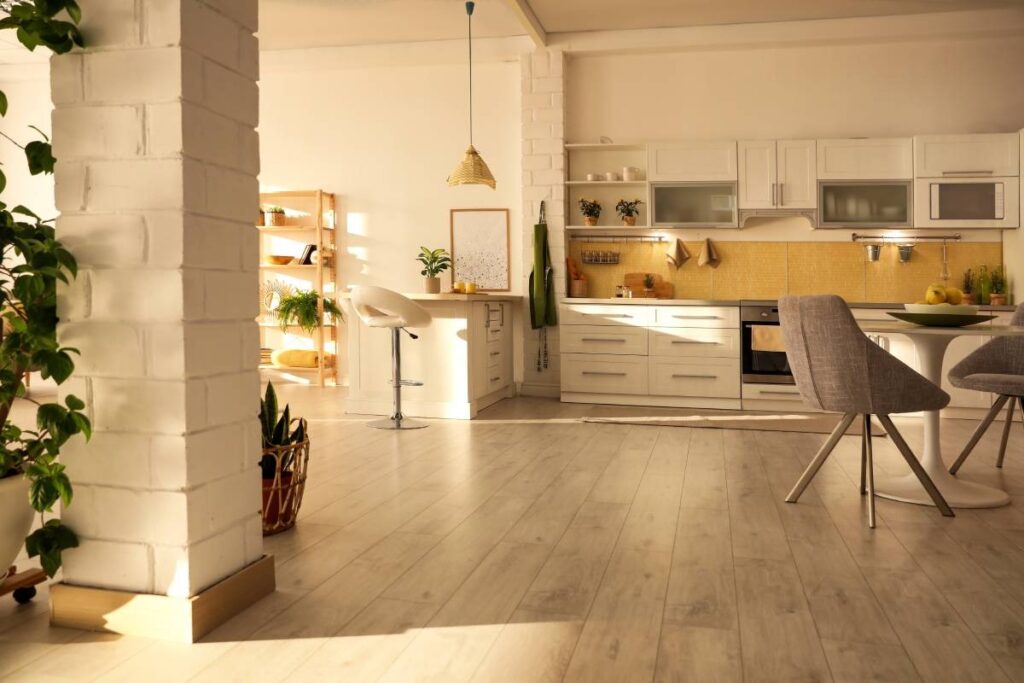
Kitchen
Hybrid only. Spills, mopping, and dishwasher leaks make this a wet area by default.
Bathroom/Laundry
Hybrid only. Laminate should not be used in these rooms under any circumstances.
Living room (no moisture risk)
Either product works well. Laminate at AC4 offers excellent scratch resistance for high-foot-traffic areas. Hybrid is quieter.
Bedroom
Either product. Budget-conscious renovators can use laminate here without any performance compromise.
Hallway/Entryway
Hybrid is preferred. These areas see tracked-in water, dirt, and concentrated traffic. The wear layer durability and waterproofing earn their cost here.
Rental/Investment property
Hybrid across the board. Tenants are harder on floors, and you will not be there to wipe up spills immediately.
Australian Climate Considerations
Global demand for durable, low-maintenance composite and hybrid flooring materials has accelerated, with the luxury vinyl tile segment projected to grow at a CAGR of 8.4% through 2033, according to Grand View Research. Much of that growth is driven by climates like Australia’s, where temperature swings and humidity levels challenge traditional flooring.
Laminate expands and contracts with temperature change because HDF responds to ambient humidity. In climates with significant seasonal variation (Melbourne winters versus Brisbane summers), this thermal movement causes gapping in winter and tight, buckling boards in summer if expansion gaps are inadequate.
SPC hybrid has a very low thermal expansion coefficient. It handles temperature swings from 5°C to 50°C with minimal dimensional change. This makes it the better choice for Queensland homes without ducted air conditioning, homes that are not climate-controlled year-round, and sun-exposed rooms.
Coastal and high-humidity environments (Darwin, Cairns, coastal NSW) expose the laminate’s moisture vulnerability. Ambient humidity alone, without any direct water contact, can cause HDF to absorb moisture and swell over time. Hybrid is the only viable option in these climates.
Environmental and Off-Gassing Factors
Both laminate and hybrid flooring use adhesives and resins in manufacturing, so both carry some off-gassing risk during installation. This is typically measured against CARB (California Air Resources Board) Phase 2 limits for formaldehyde emissions.
Reputable brands in both categories certify compliance with CARB Phase 2 or the stricter FloorScore standard. Always ask for this certification when purchasing.
Laminate’s HDF core is wood-based, which some buyers prefer from a sustainability perspective. Hybrid’s polymer core is petroleum-derived and is not biodegradable. However, hybrid flooring’s longer lifespan and lower replacement rate reduce its environmental footprint over its lifetime in high-wear or moisture-prone areas.
Neither product should be installed without adequate ventilation for the first 72 hours after installation.
The Verdict: Which Floor Wins?
Neither product wins outright: the right choice depends on where the floor will live.
Laminate wins on scratch resistance per dollar in dry, low-risk rooms. If you are flooring a bedroom, study, or low-traffic living room with no moisture exposure, quality laminate at AC4 delivers exceptional durability for less money.
Hybrid wins in every other scenario. Kitchens, bathrooms, laundries, open-plan spaces, coastal homes, rental properties, and rooms without climate control all favour hybrid. Its waterproof core eliminates the most common and costly failure mode of laminate, and its dimensional stability makes it the right fit for the Australian climate.
For whole-home flooring, the most practical approach for most Australian households is hybrid throughout, using a mid-range 6mm or 8mm SPC product with a built-in underlay. The premium over laminate is typically recovered in avoided replacement costs within ten years.
The drawbacks of hybrid flooring, including subfloor preparation requirements and the higher upfront cost, matter more in some installations than others, and are worth weighing before you finalise your decision.
If you’re still unsure which option is right for your space, it helps to get advice based on your layout, budget, and lifestyle. You can explore our full range of flooring solutions and speak with a specialist on our homepage.
FAQ
What is your reaction?


You may also like

Best Flooring for Dogs and Cats: What Actually Holds Up